Instructional design / eLearning / Learning video
Instructional Designer & Learning Experience Designer
I design learning and build it: Storyline, Rise, video and job aids.
At Carvana I ran a 9-person learning studio, 6 instructional designers and 3 media producers, shipping a complete course every two weeks: 150+ in all.
Most of my courses were for leaders and managers at a 30,000+ person company.
- Storyline 360
- Rise 360
- After Effects
- Illustrator
- Photoshop
- Word

Onboarding New Hire Program
Five courses, one narrator, every new hire.
- Audience
- Every new hire, company-wide.
- My role
- Led the program as project manager and instructional designer. Built the Storyline courses and animated the narrator in After Effects.
- Format
- Self-paced eLearning: 3 Rise courses, 2 Storyline courses
- Tools
- Storyline 360
- Rise 360
- After Effects
- Illustrator
- Photoshop
- Word
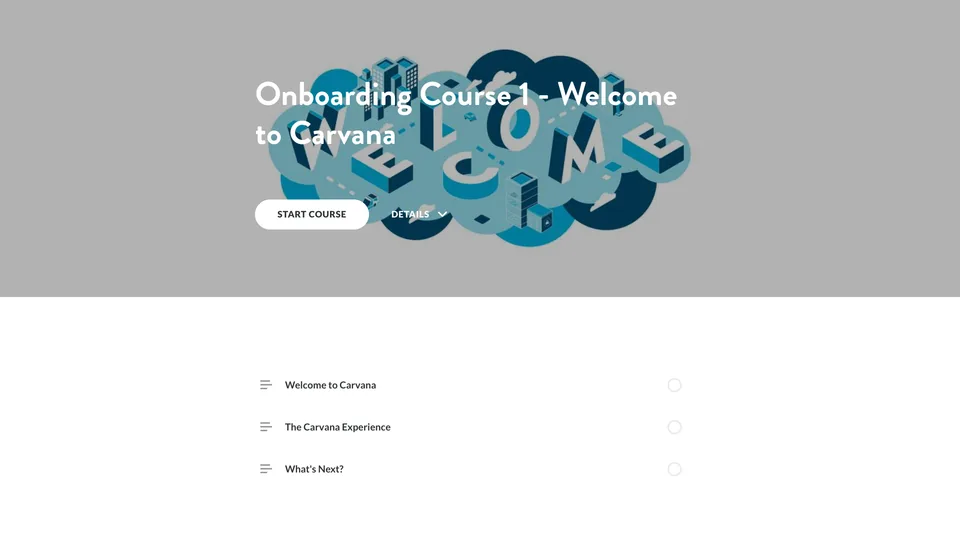 Rise
Course 1: Welcome to Carvana
The company and the customer experience
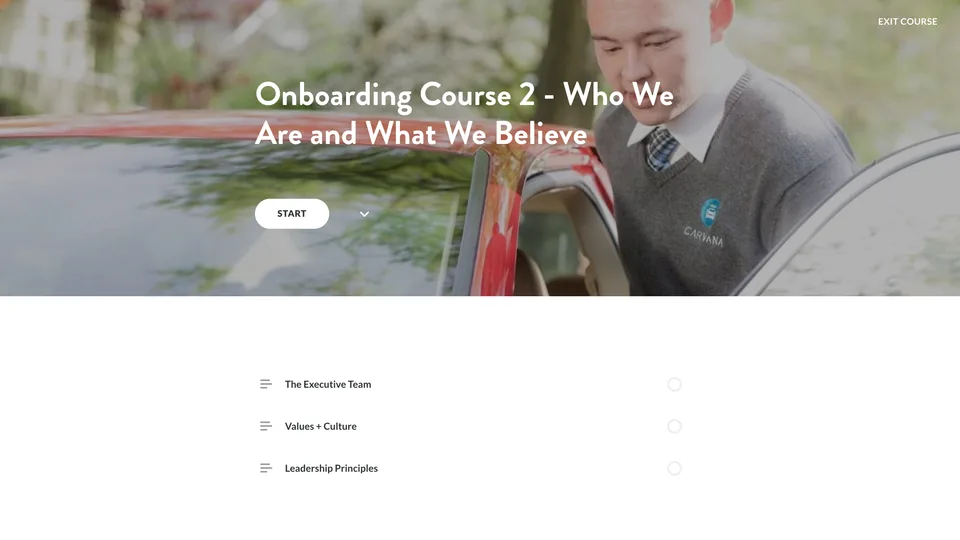 Rise + Storyline
Course 2: Who We Are and What We Believe
Leaders, values and Leadership Principles
 Storyline
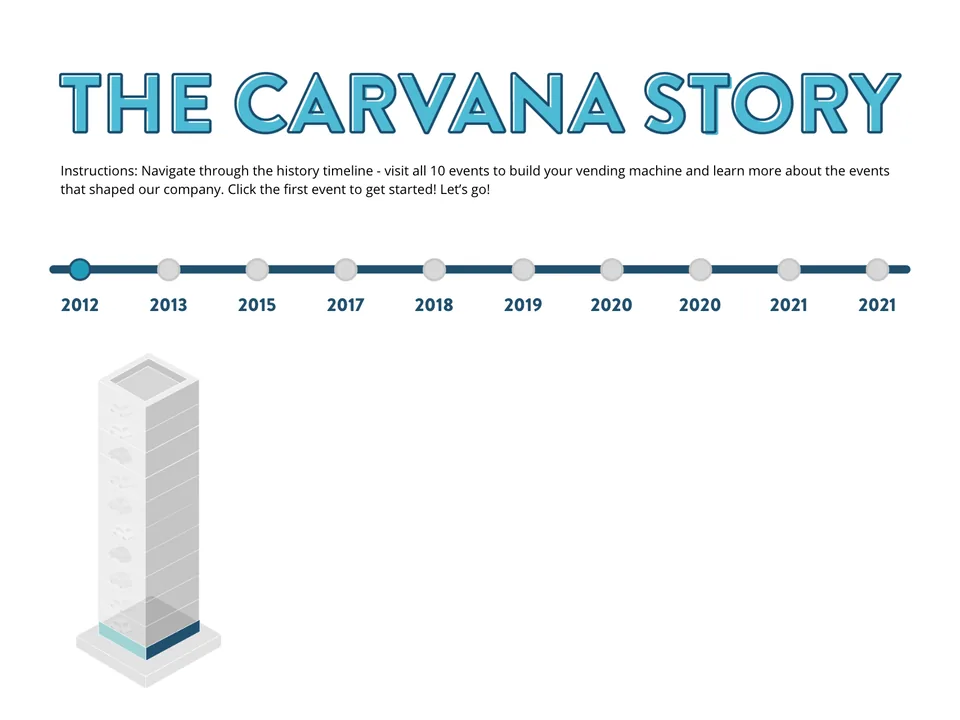
Course 3: The Carvana Story
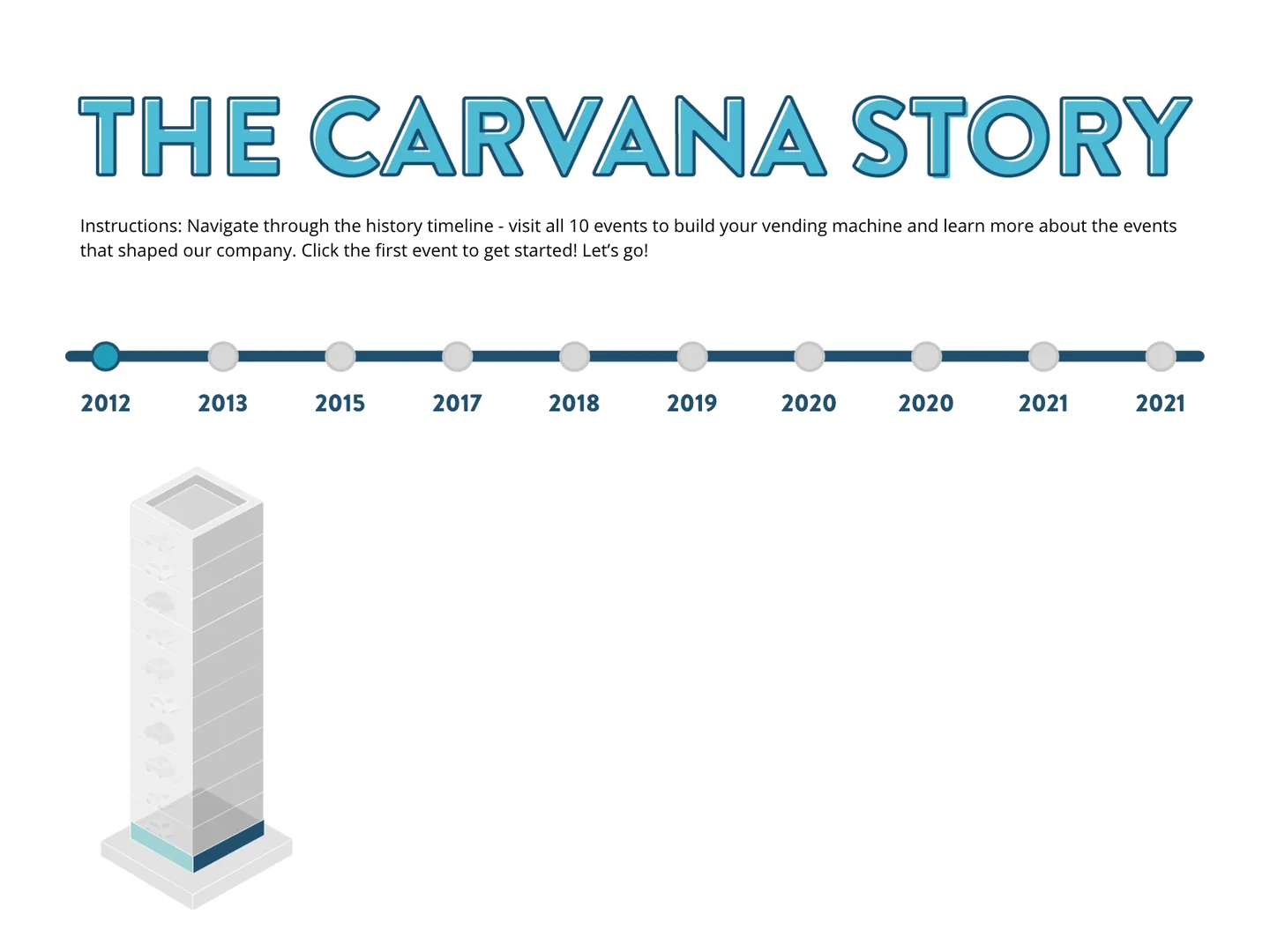
Company history as a ten-stop timeline
Try it: The Carvana Story (opens a new tab)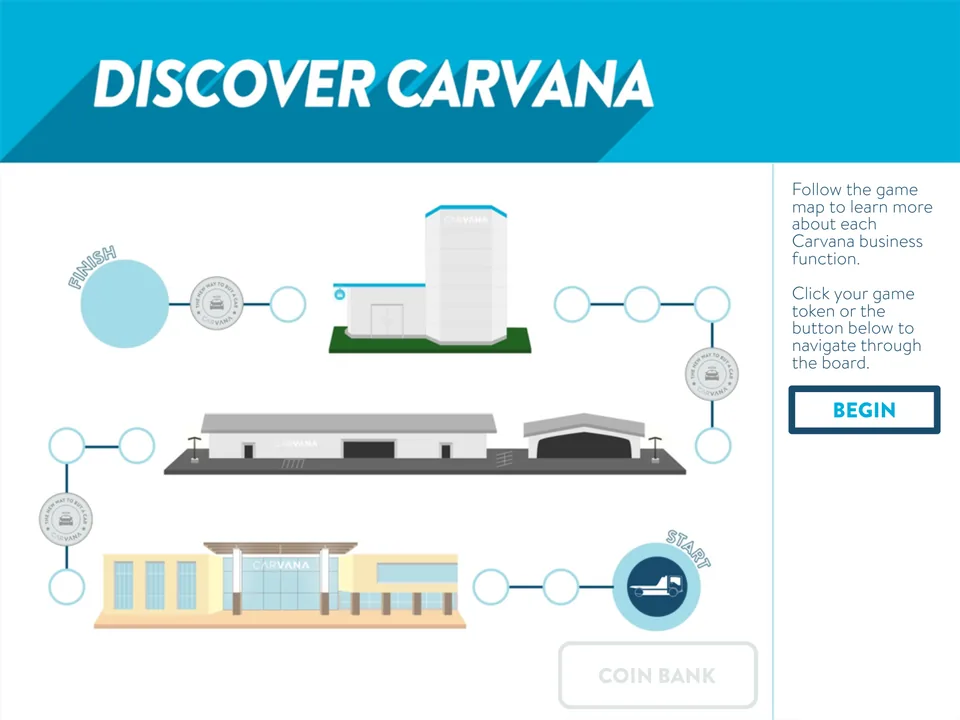 Storyline
Course 4: Discover Carvana
The business, team by team, as a board game
Try it: Discover Carvana (opens a new tab)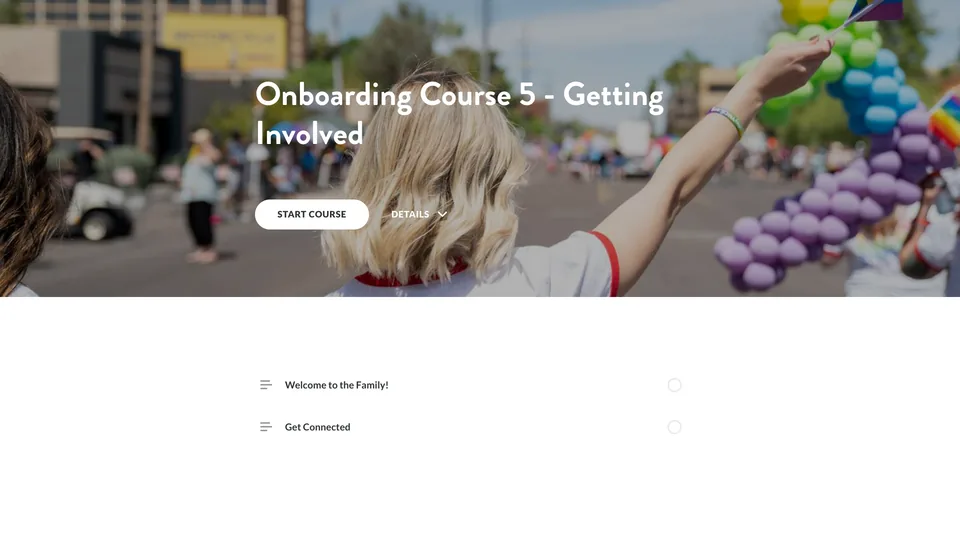 Rise
Course 5: Getting Involved
Groups and ways to connect


The problem
Replace the first version of new-hire training with one journey through Carvana’s story, values and teams, built to scale with hiring.
Design decisions
- One guide, Charlie, narrates all five courses, so they play as one journey rather than five modules.
- Rise for read-and-watch content that works on any device. Storyline only where a game earned its build time.
- History as a road trip: ten timeline stops, each adding a level to a car vending machine that doubles as the progress meter.
- The business as a game board: each space is a Carvana fact, coins go in a coin bank, and a short knowledge check closes it out.
- Shared isometric art across courses 3 and 4, so the two Storyline builds look like one world.
- Closed captions on both Storyline courses.
Result
Rolled out company-wide to new hires.
What the clip shows
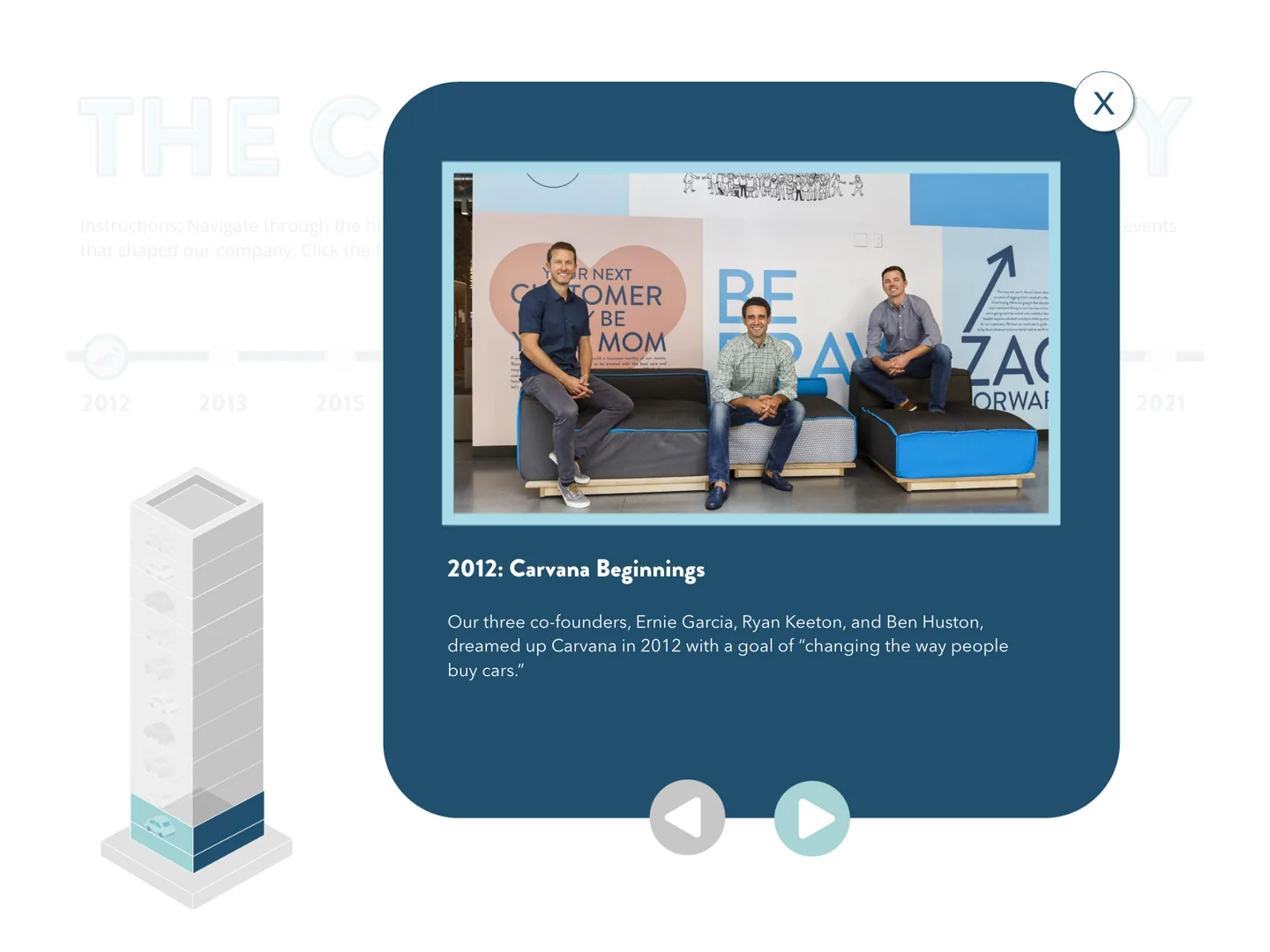
- Course 3, The Carvana Story. Ten stops on a timeline, from 2012 to 2021.
- The learner opens the first stop: 2012, Carvana beginnings.
- Each stop adds a level to the car vending machine on the left.
- Closing the card returns to the timeline, with three stops visited.
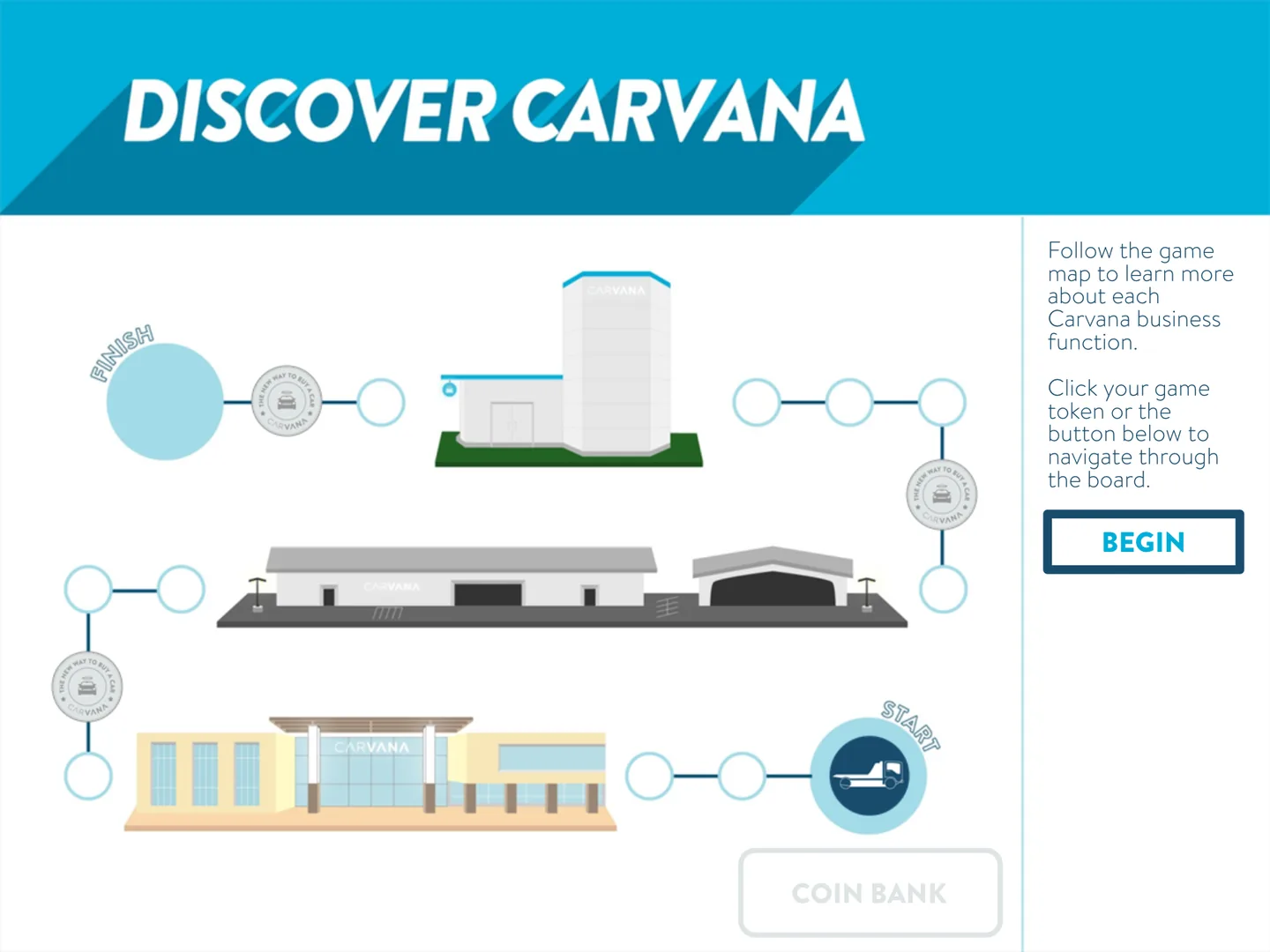
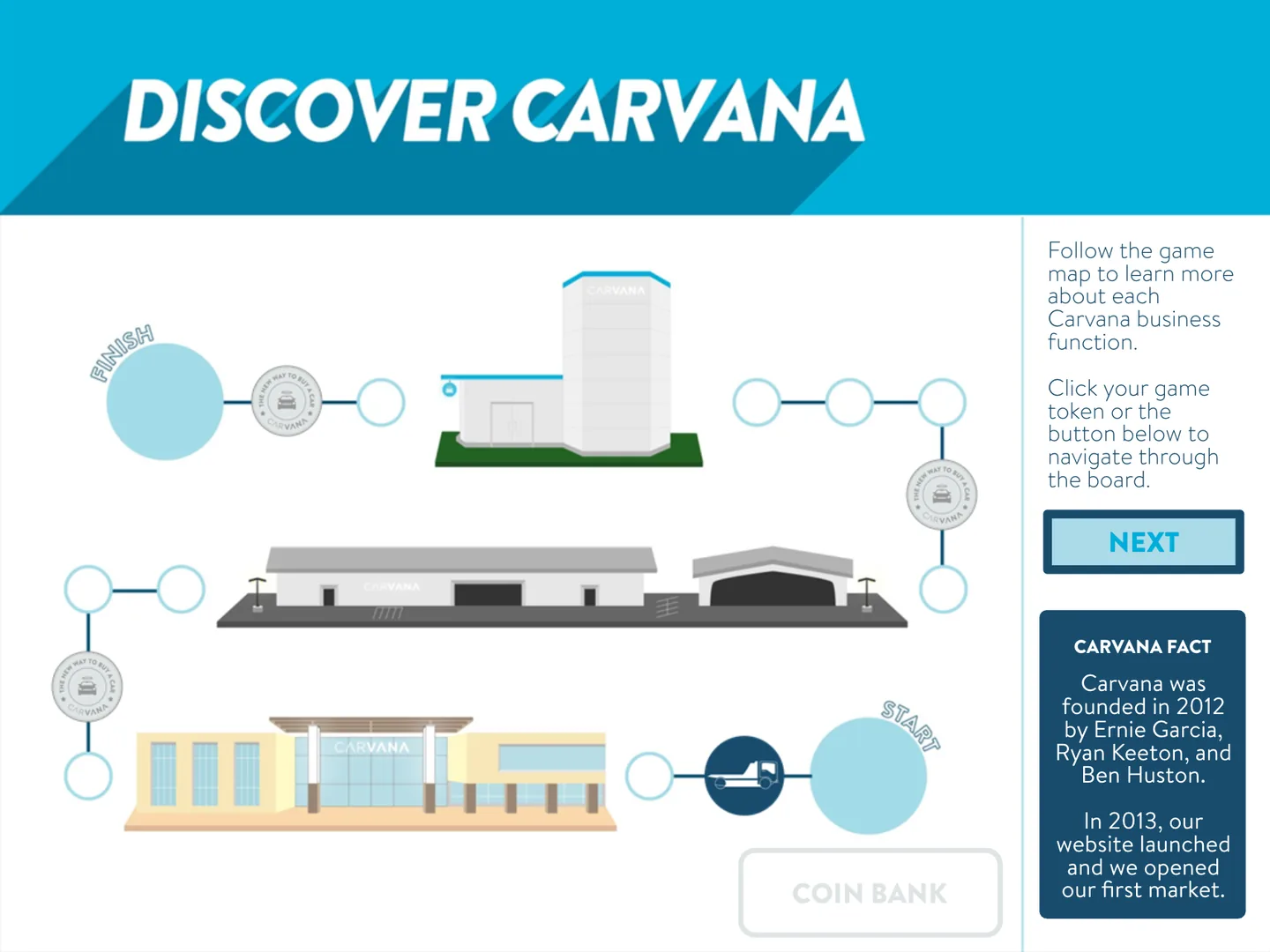
- Course 4, Discover Carvana. A game board of Carvana locations and teams.
- The learner moves the game token one space at a time. Each space shows a Carvana fact.
- Facts can earn coins for the coin bank, used in the knowledge check at the end.
Live demos: the real course, running in your browser.
Try The Carvana Story (opens a new tab)Try Discover Carvana (opens a new tab)Course 3: visit all ten stops to build the vending machine. 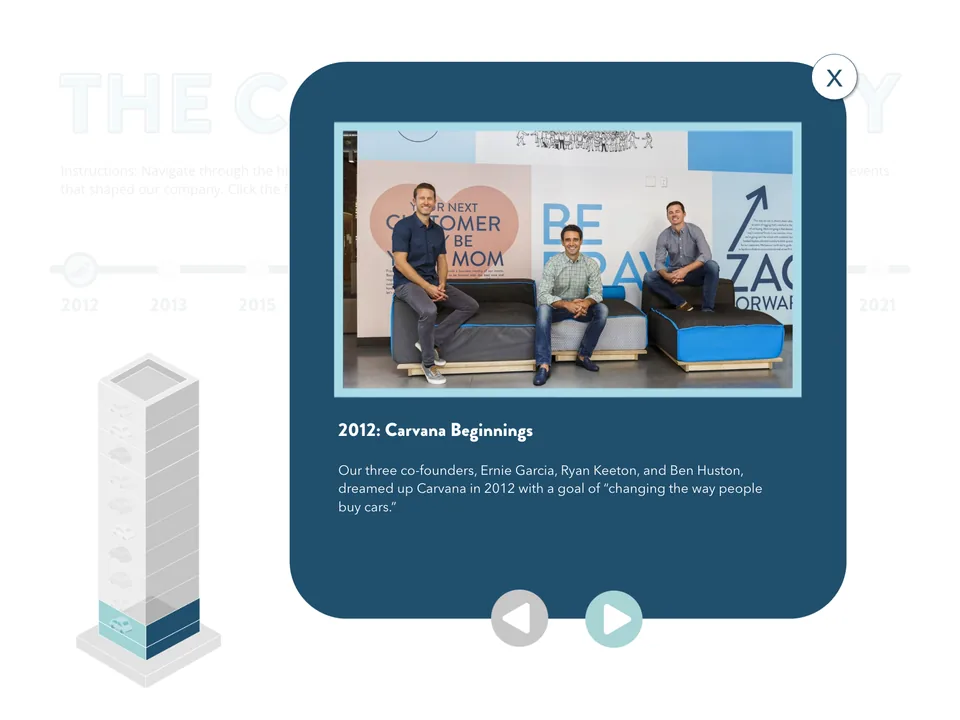
Each stop is a short story card with a photo. Course 4: the board, from Start to Finish. 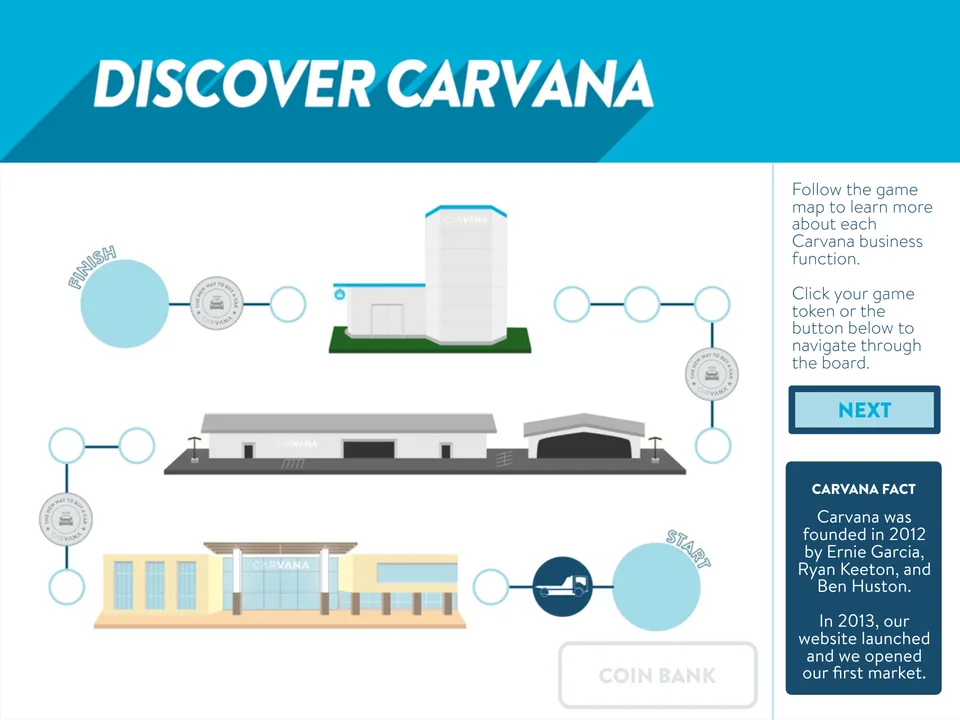
Each space reveals a Carvana fact.
Coaching 101
Diagnose a development moment before you have one for real.
- Audience
- Leaders and managers.
- My role
- Designed and built it in Storyline; animated the five scenarios.
- Format
- Self-paced eLearning, Storyline
- Tools
- Storyline 360
- After Effects
- Illustrator
The problem
Leaders mixed up feedback and coaching, and rarely practised spotting which one a moment called for.
Design decisions
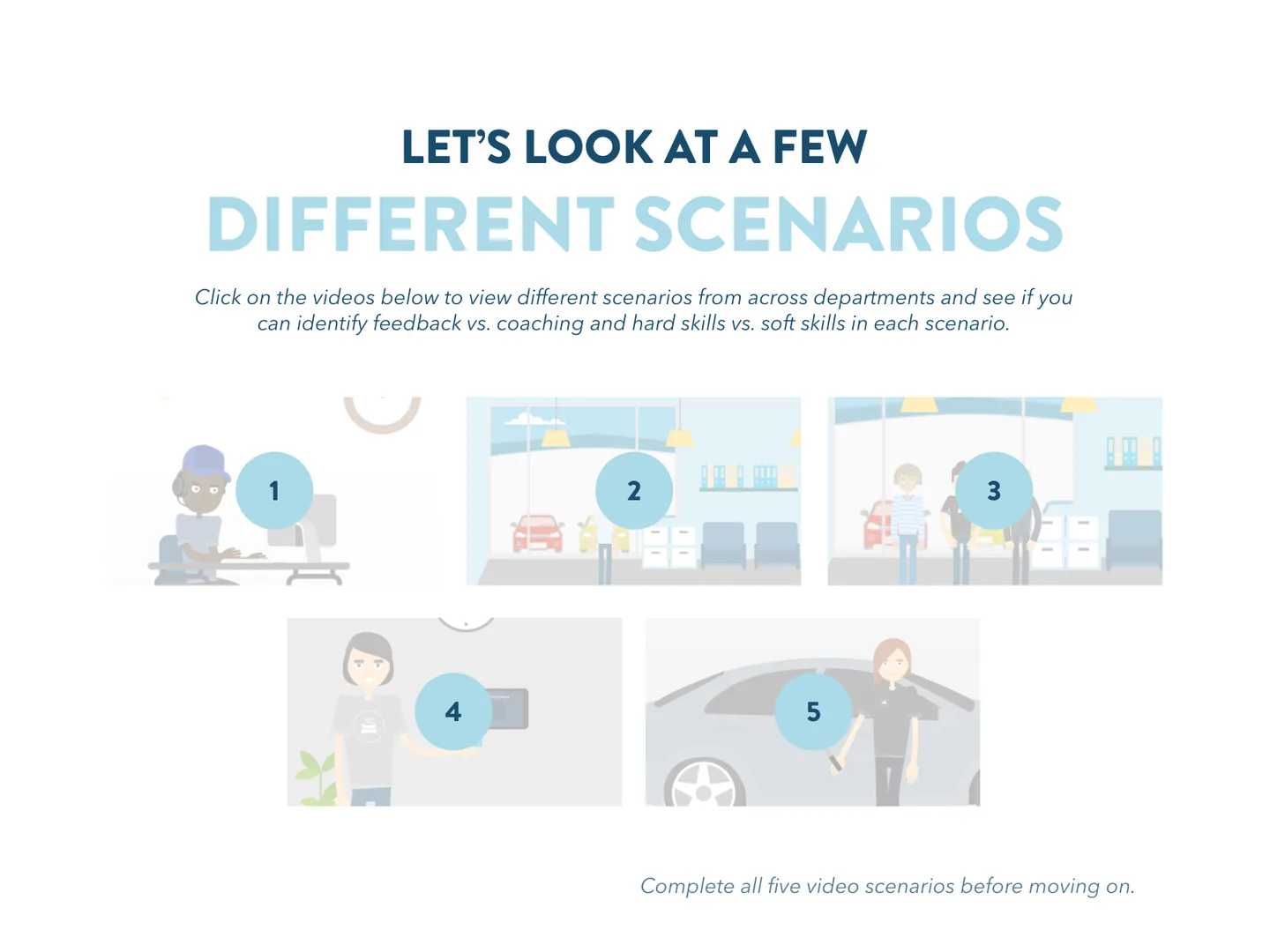
- Five animated scenarios from across departments, 32 to 41 seconds each, instead of live action: no crew, a consistent cast, easy to update.
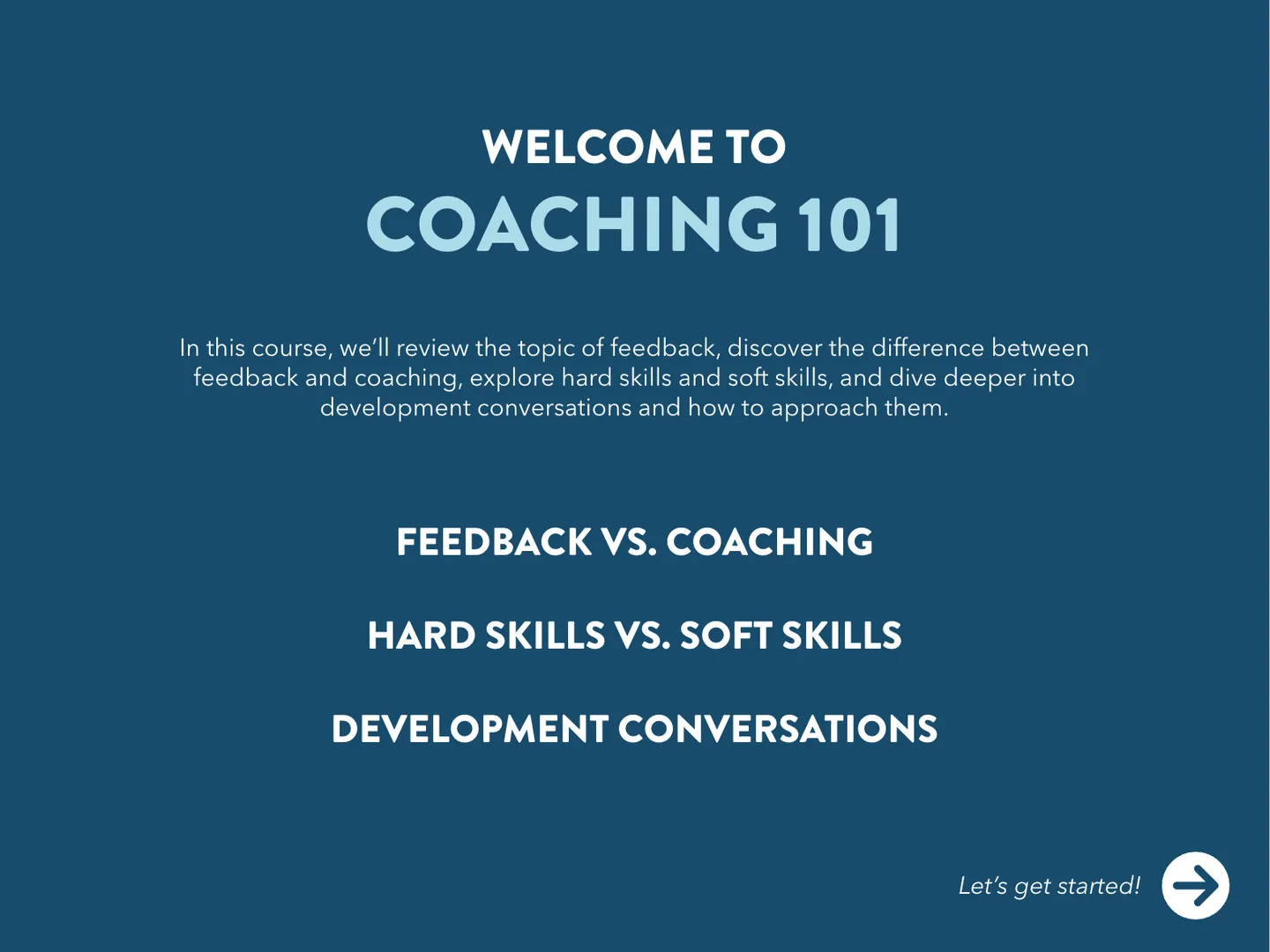
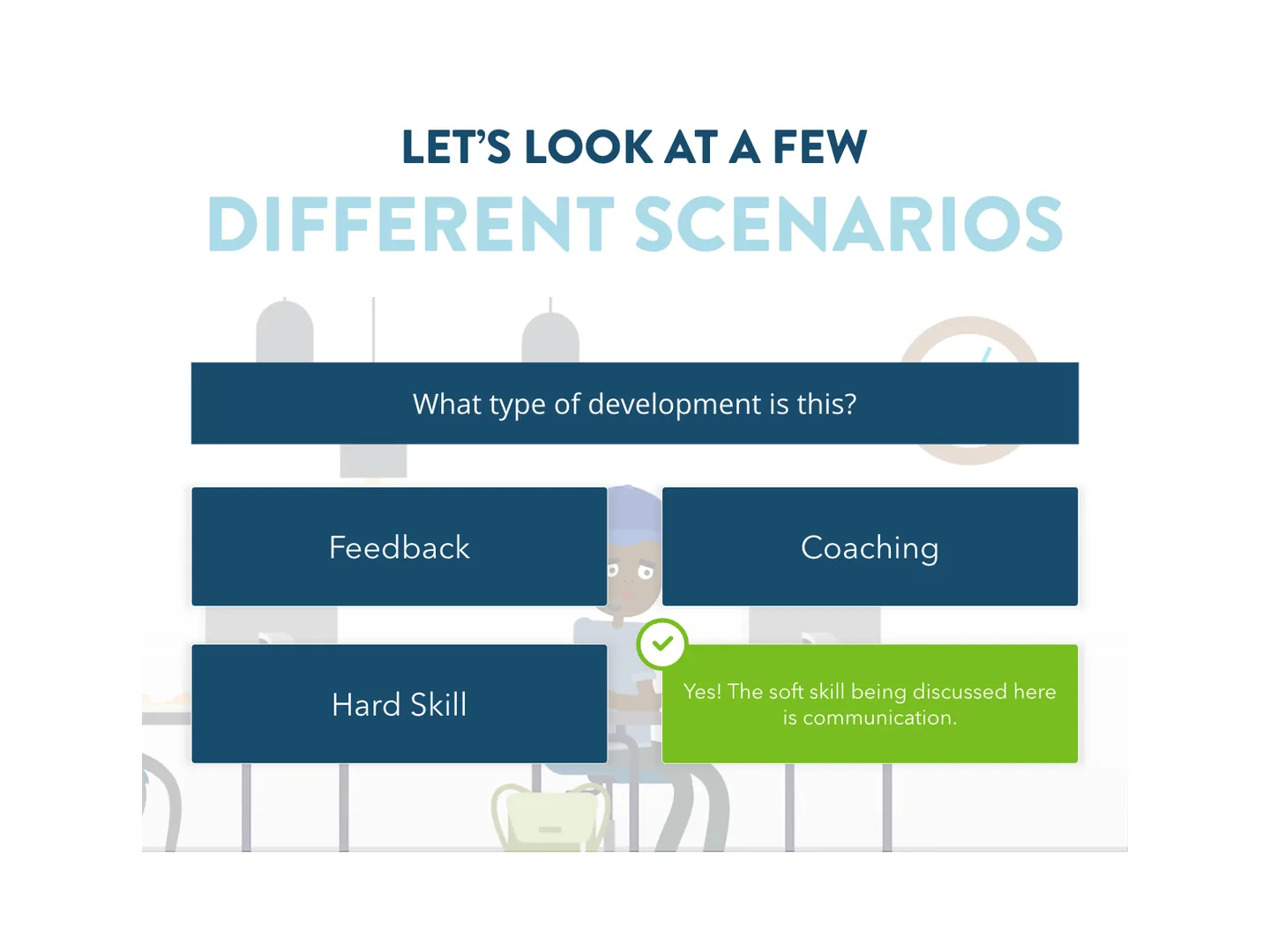
- After each scenario the learner names the development need, feedback or coaching, a hard skill or a soft skill, and gets the reasoning back at once.
- The learner picks the order of the scenarios; all five must be done before moving on.
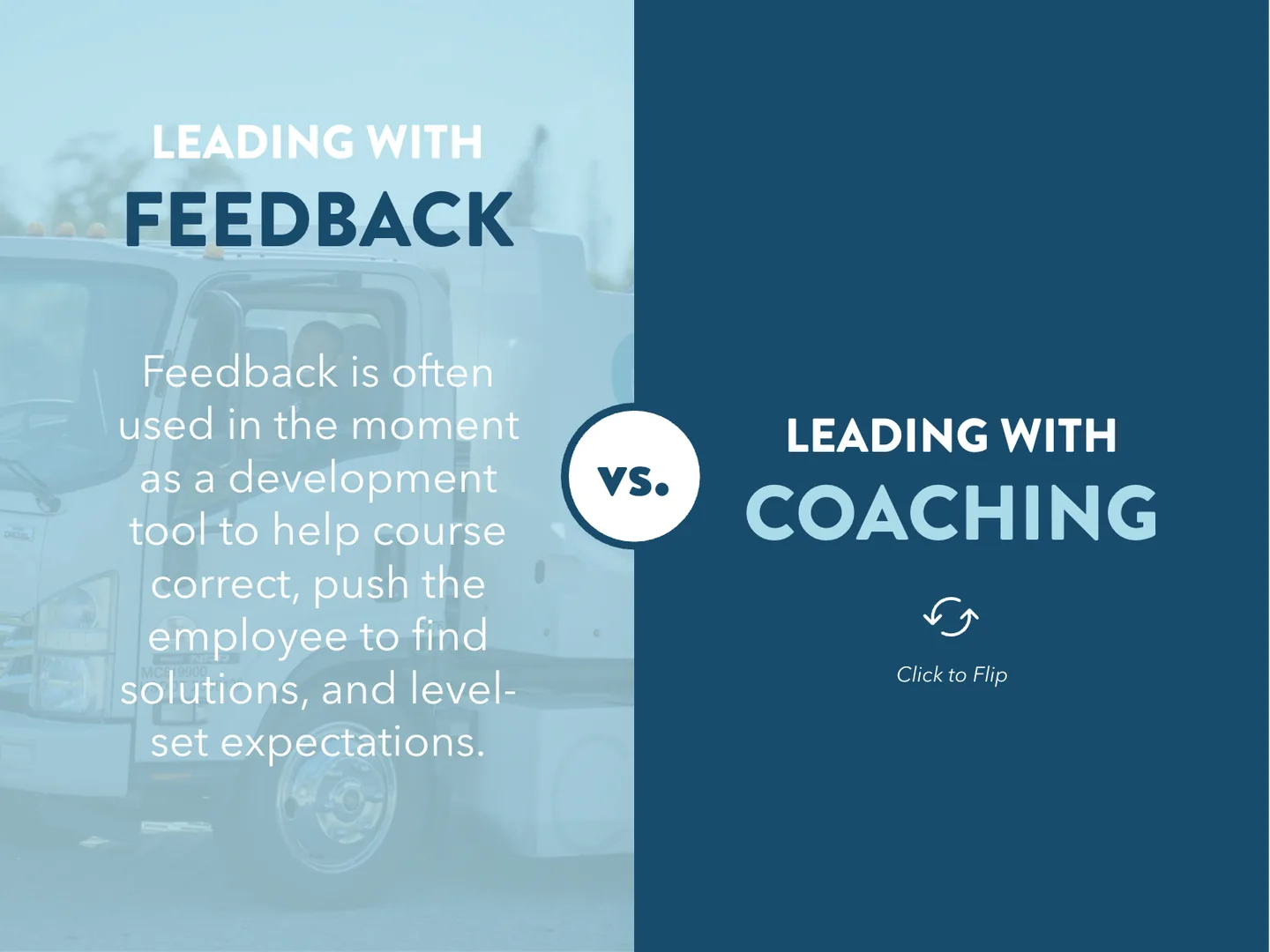
- Flip cards contrast leading with feedback and leading with coaching; a drag-and-drop sort practises hard and soft skills.
Result
Rolled out company-wide.
What the clip shows
- Coaching 101. Five animated scenarios from across departments.
- The learner picks scenario 1.
- The scenario plays: a team member at work. (Its sound is in the live demo.)
- Then the learner names the development need: feedback or coaching, a hard skill or a soft skill.
- Feedback explains the answer: a soft skill, communication.
Live demo: the real course, running in your browser.
Try Coaching 101 (opens a new tab)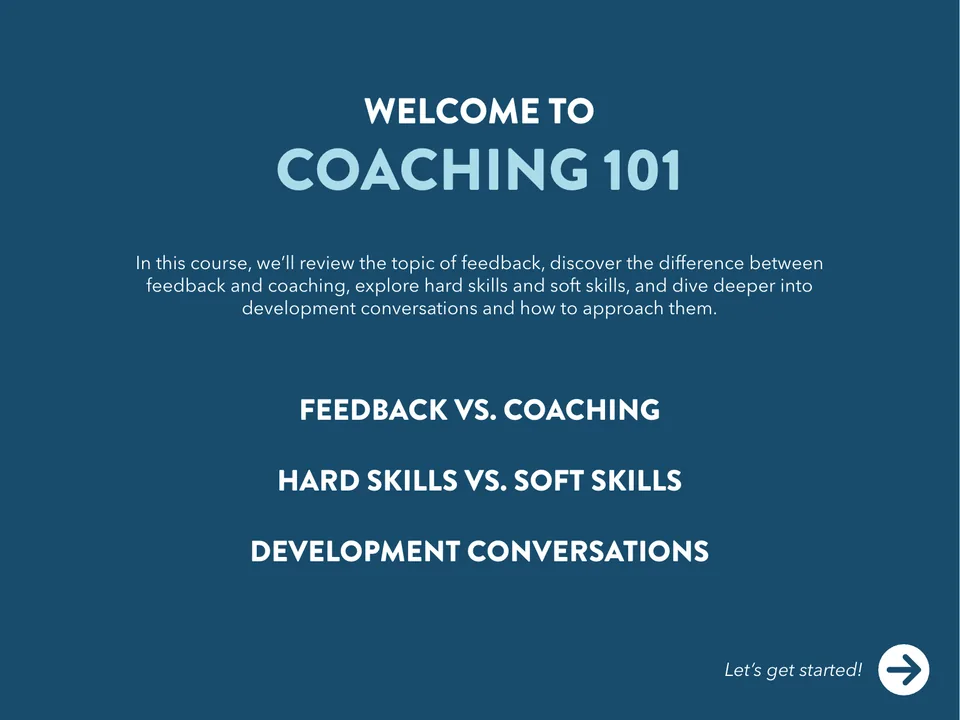
Three parts, stated up front. 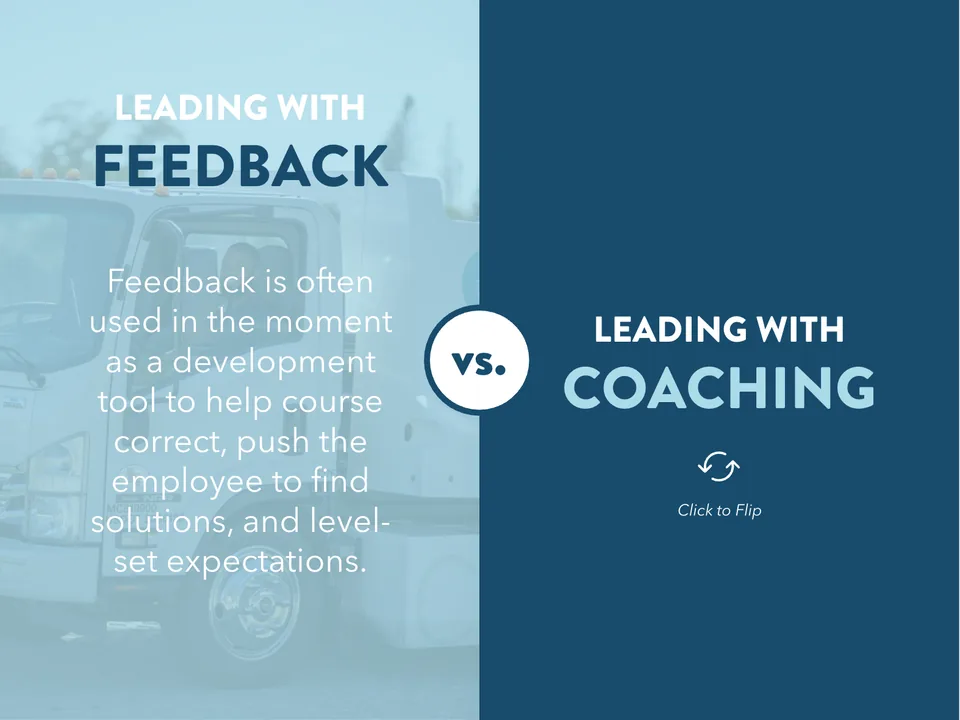
Flip cards: feedback vs. coaching. 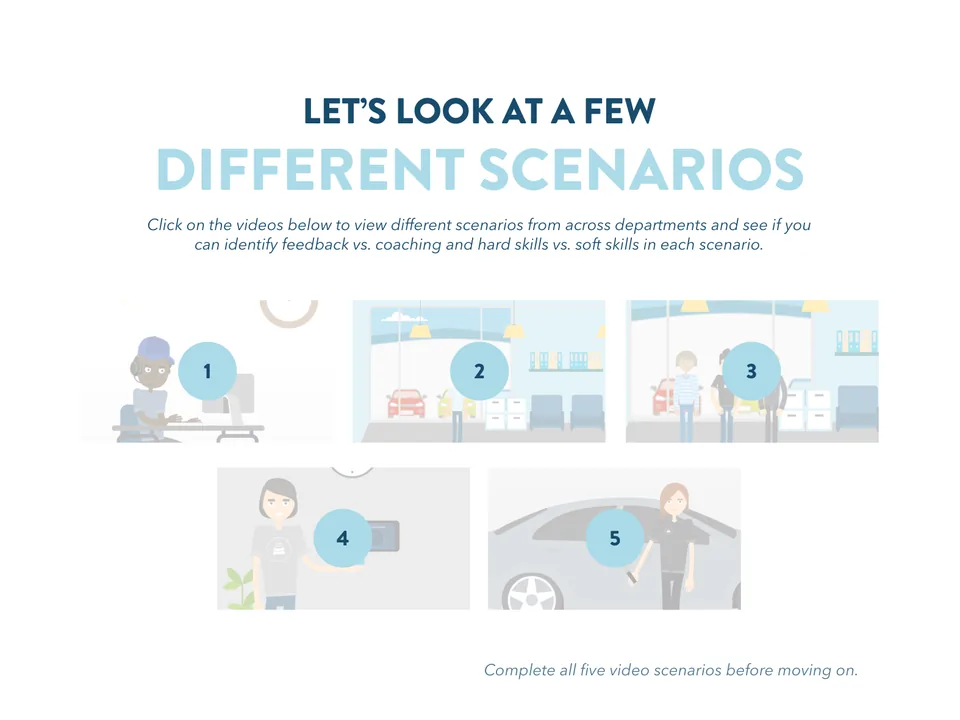
The learner chooses the order. 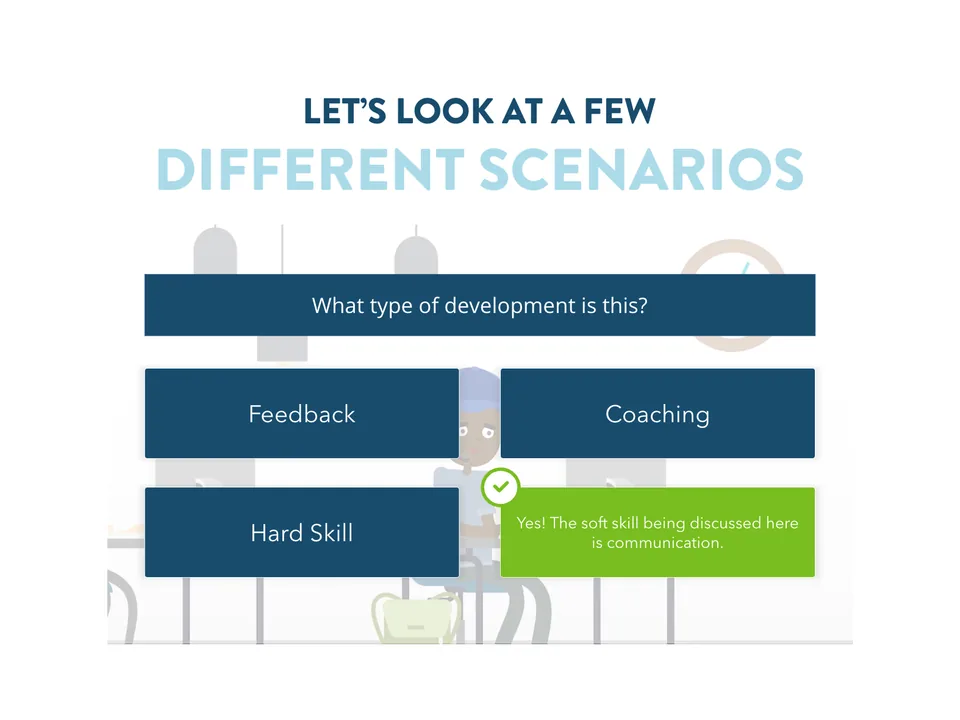
Instant feedback on each diagnosis.
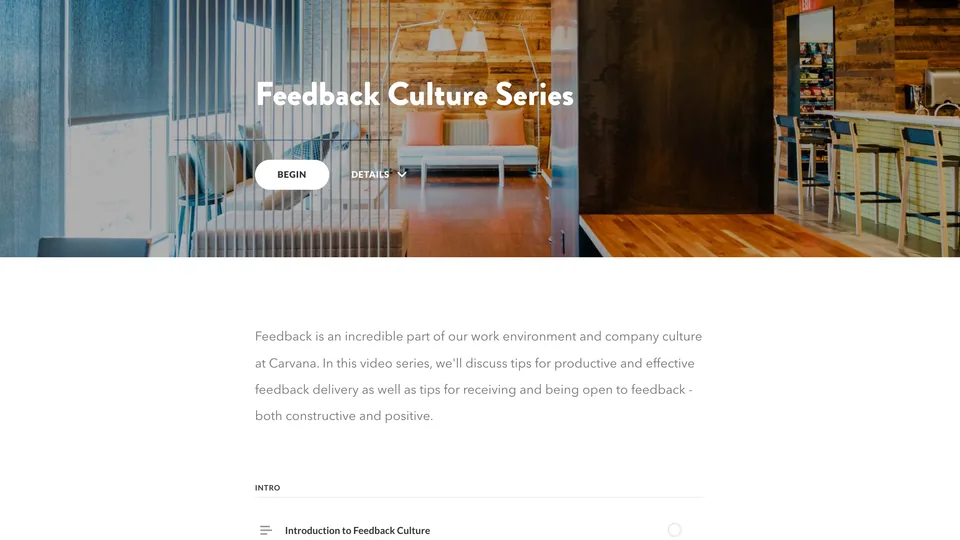
Feedback Culture Series
Four short episodes and a one-page guide.
- Audience
- All employees, company-wide.
- My role
- Produced the four video episodes and presented them on camera; built the Rise course and the Quick Reference Guide.
- Format
- Video series in Rise, with a printable job aid
- Tools
- Rise 360
- Storyline 360
- After Effects
- Illustrator
The problem
Make feedback a habit at every level, with one shared way to give it and receive it.
Design decisions
- Four short episodes, 2 to 5½ minutes, instead of one long module.
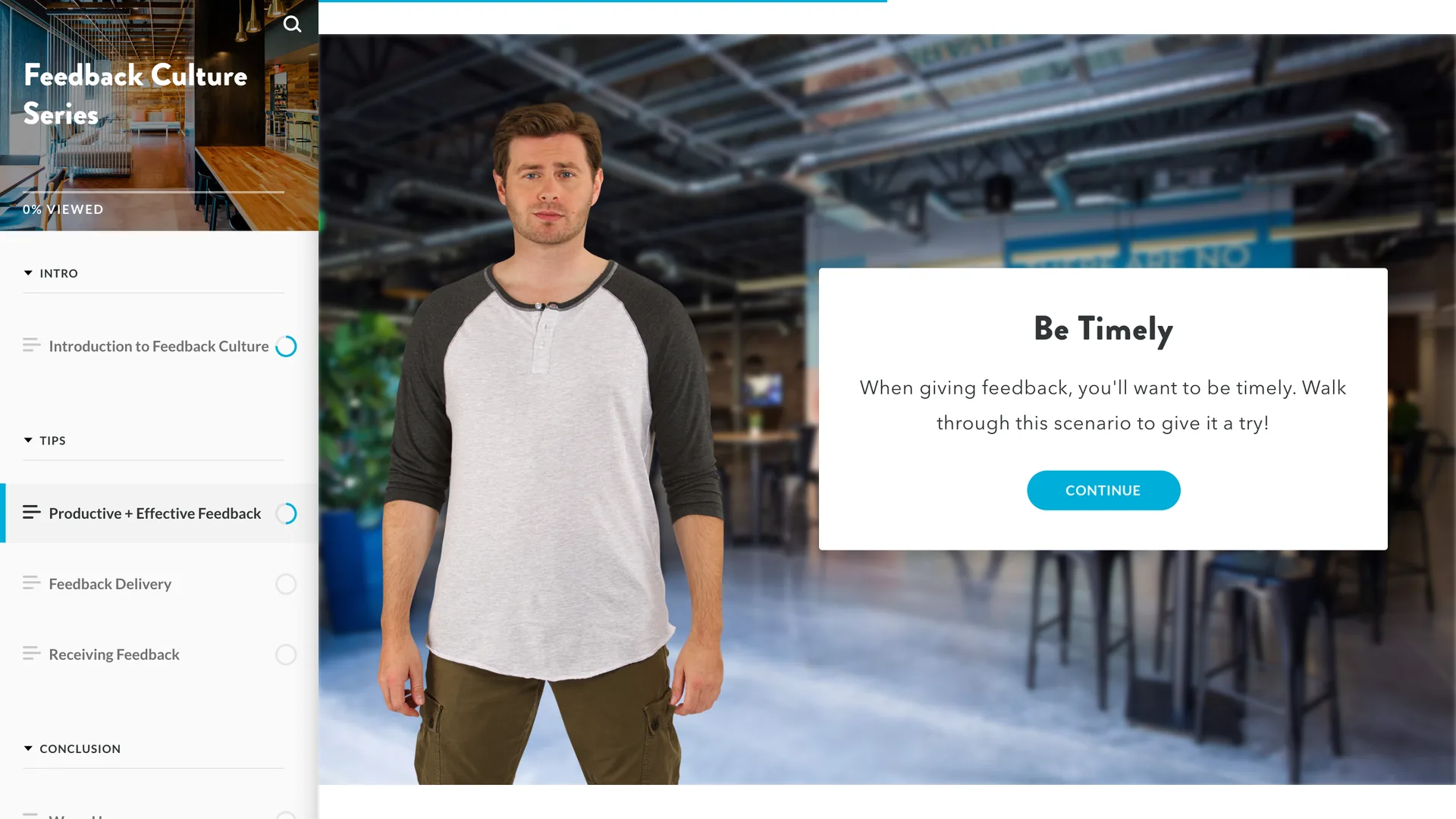
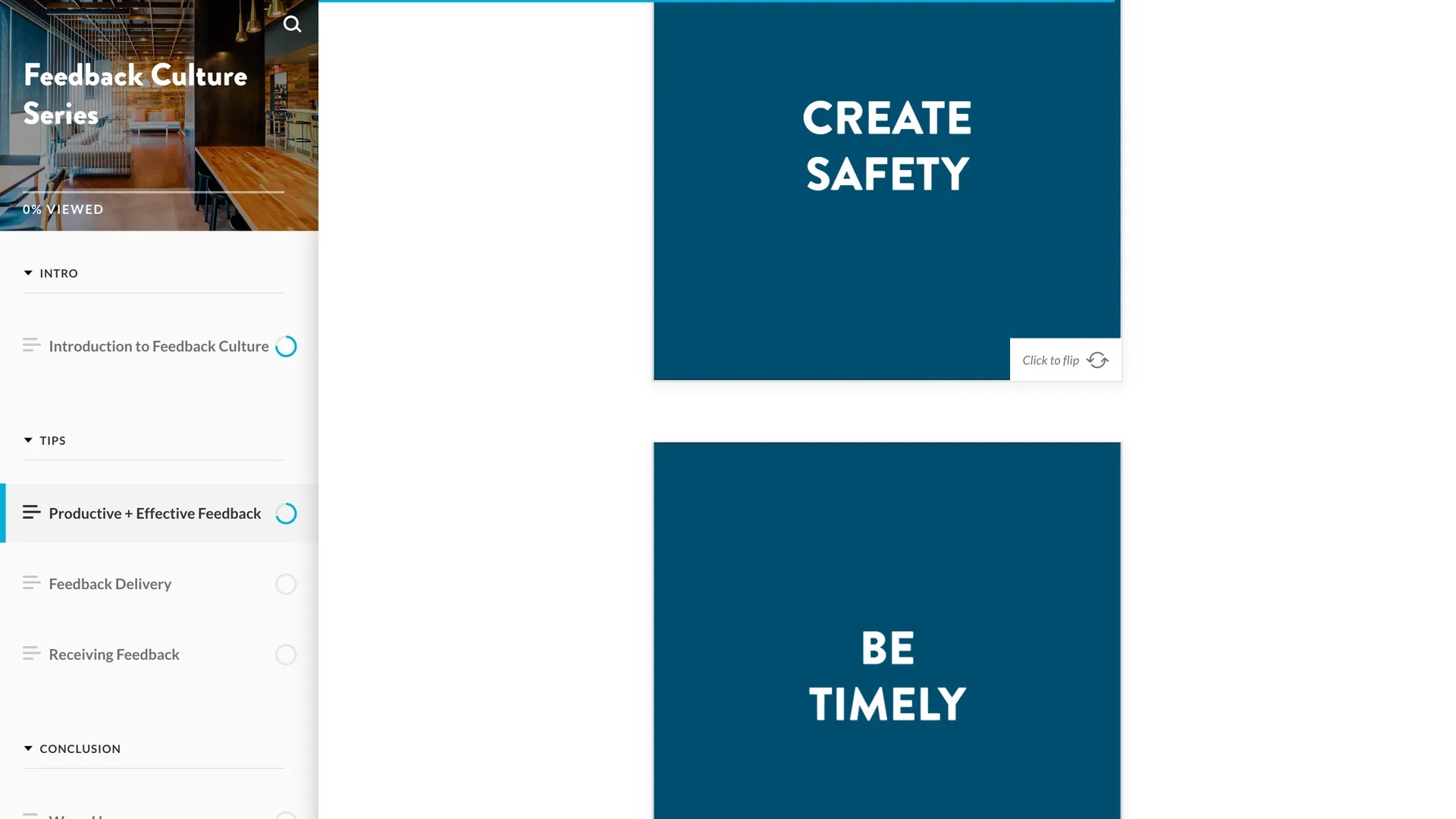
- Practice after each episode: a branching scenario and flashcards to rehearse the tips.
- A one-page Quick Reference Guide to keep at hand after the course.
- Caption files for every episode.
- Next steps for leaders: related courses in the Workday Learning LMS.
Result
Rolled out company-wide; revised in February 2021.
Transcript
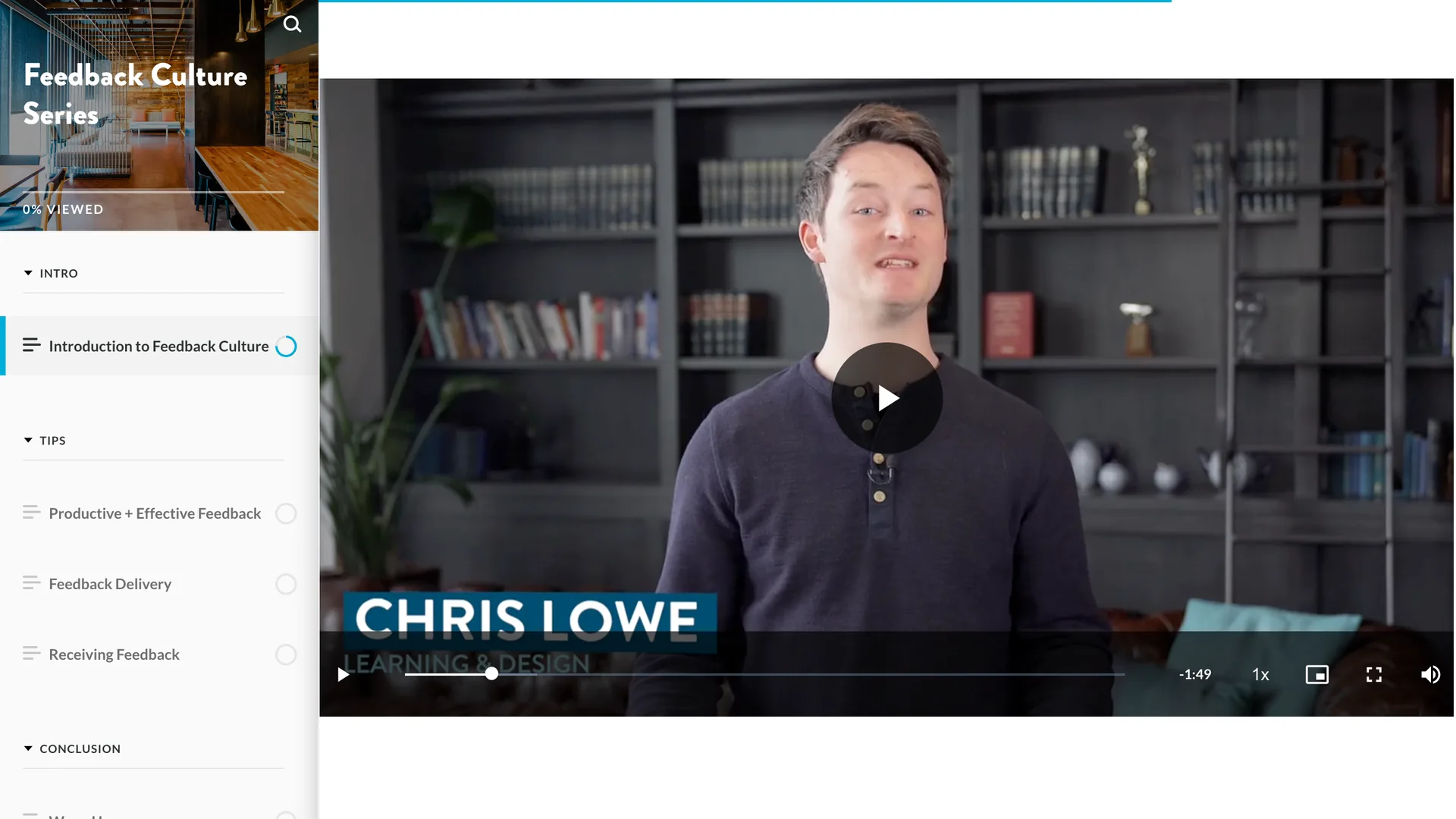
Welcome to our series on feedback! In this series, we're going to be sharing some tips for productive and effective feedback delivery, as well as tips for receiving and being open to feedback. Before we dive in, let's talk about why we believe feedback is an incredibly important part of our work environment and company culture at Carvana. Just to show you how important feedback is.
A Gallup survey showed that 43% of highly engaged employees received feedback at least once a week, compared to only 18% of employees with low engagement. In fact, four out of ten workers are actively disengaged when they get little to no feedback. Oftentimes, when we hear the word feedback, we think about negative or constructive feedback. We may even think back to previous annual performance reviews and the sinking feeling of finding out you have room for improvement or you've made a mistake.
Feedback can be positive, too, and should always encourage us to grow, improve and develop personally and professionally. Without feedback none of us would be where we are today. When we talk about feedback, we're not just talking about manager to employee feedback or a formal review process. We believe in anyone, to anyone feedback that is ongoing.
We're all in this together.

The course: an intro, three tips episodes and a wrap-up. 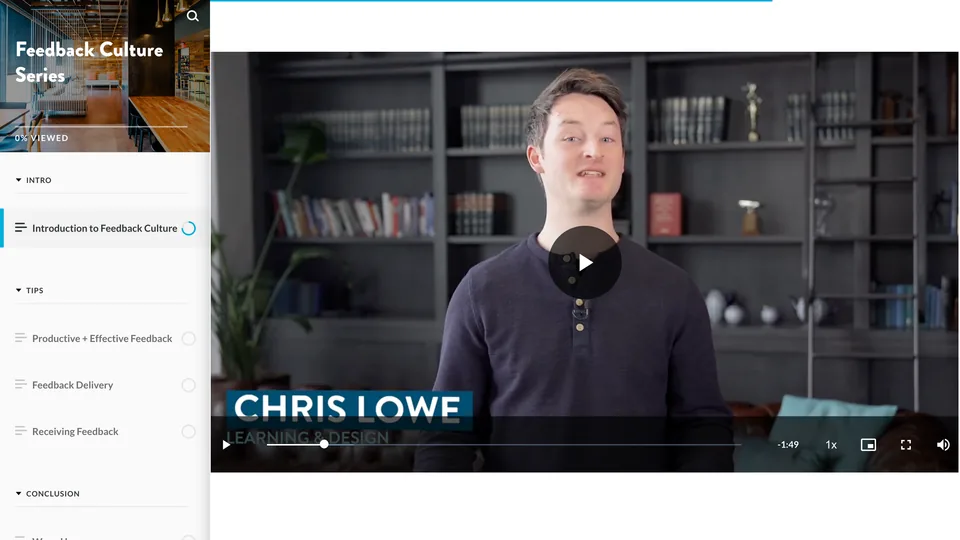
Each lesson leads with its episode. 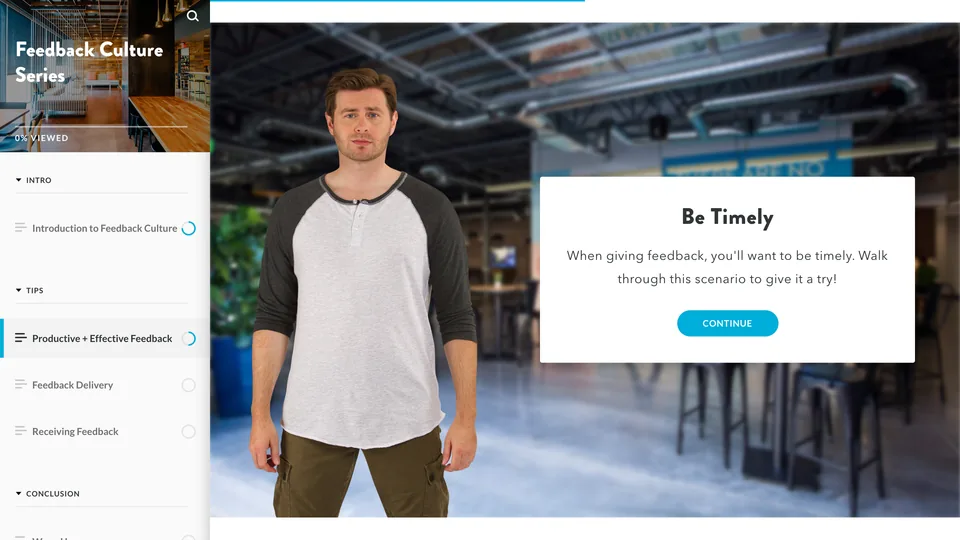
A branching scenario to practise. 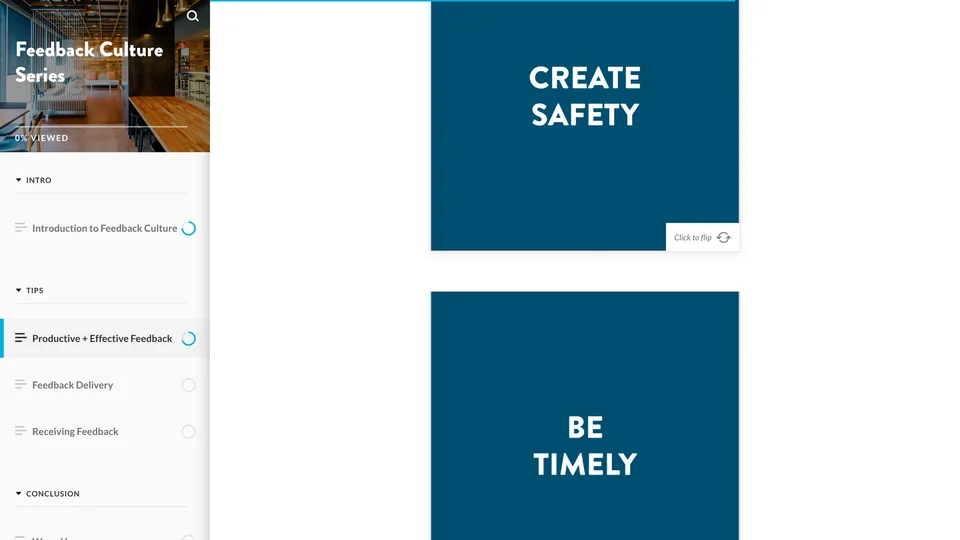
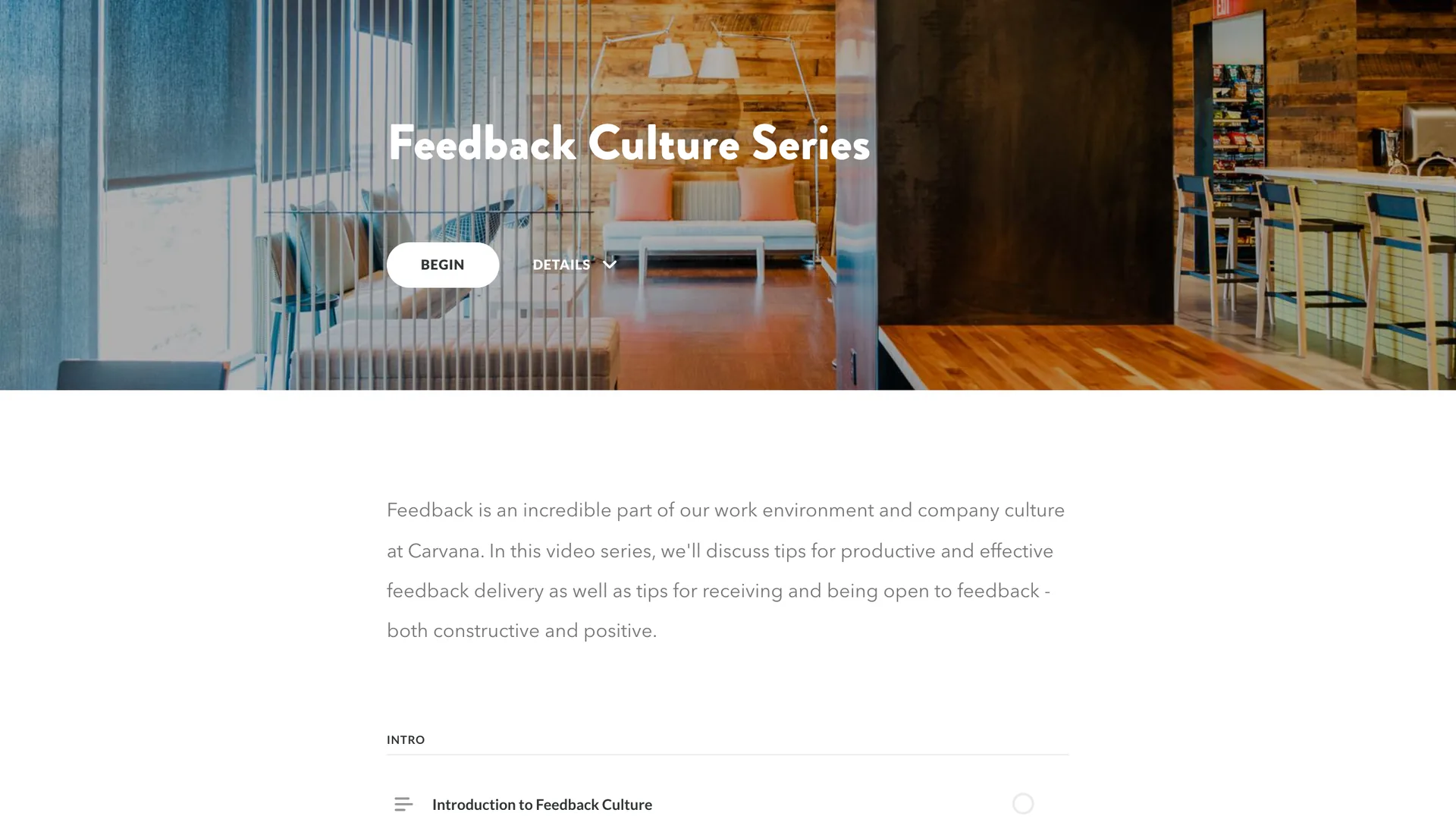
Flashcards to rehearse the tips.
Building Trust with Your Team
A blended module for TLIT (Team Lead in Training), the program I built from the ground up.
- Audience
- Market Ops team leads in training.
- My role
- Designed the blended flow; built the course, the pre-work and the worksheet.
- Format
- Blended: pre-work, Rise course, worksheet
- Tools
- Rise 360
- Storyline 360
- Illustrator
- Photoshop
- Word
- SurveyMonkey
Pre-work
A private 15-question trust self-assessment, scored into four bands
Rise course
Eight short lessons, with Storyline blocks for the interactions
Worksheet
Reflection, SMART goals and activities to run with the team
The problem
New team leads in a fast-growing operation had to earn trust quickly, and repair it when it broke.
Design decisions
- A private self-assessment first (“you won’t be sharing your scores with anyone else”), so answers stay honest.
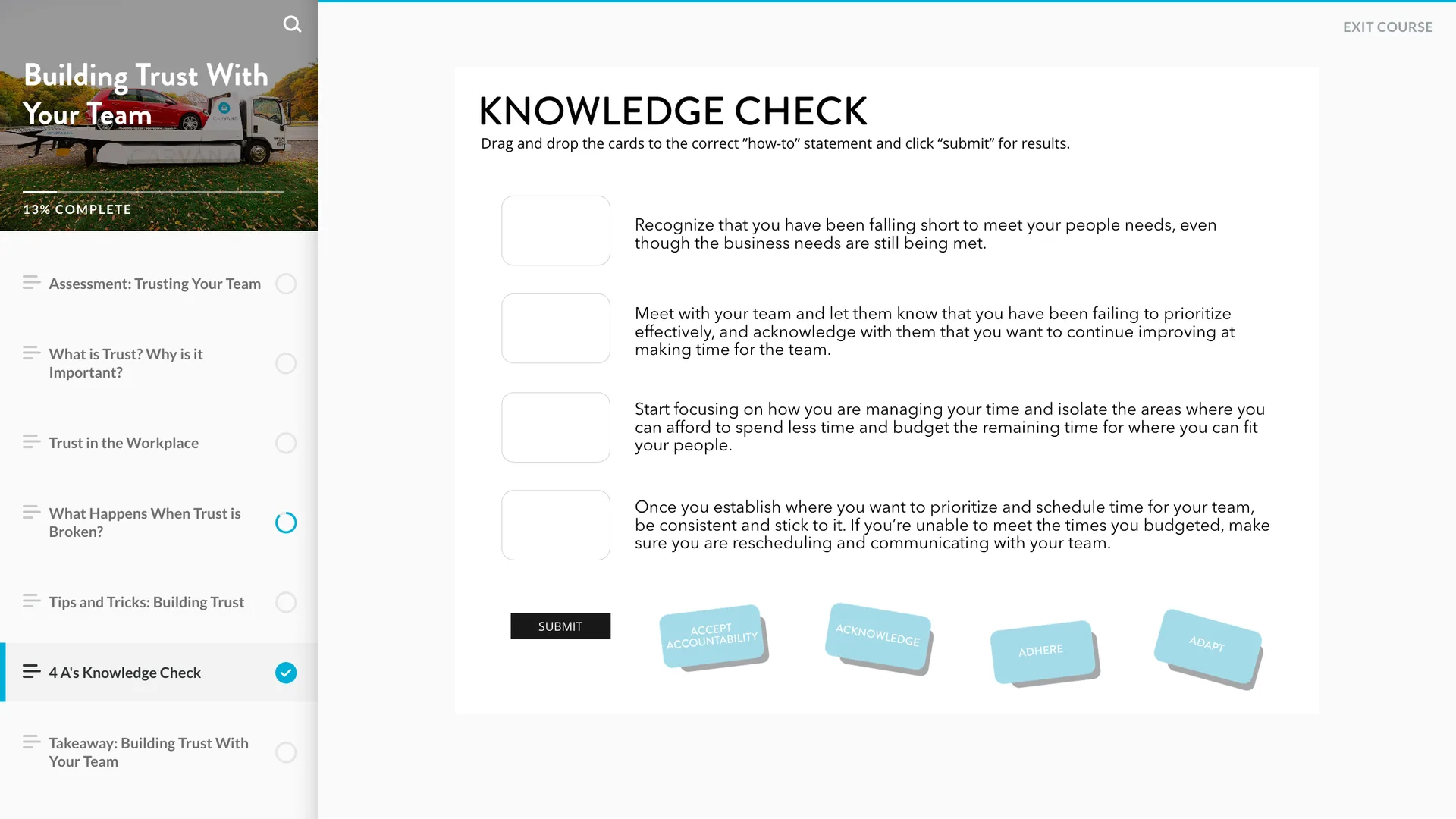
- One repair model to remember, the 4 A’s: Acknowledge, Accept accountability, Adapt, Adhere.
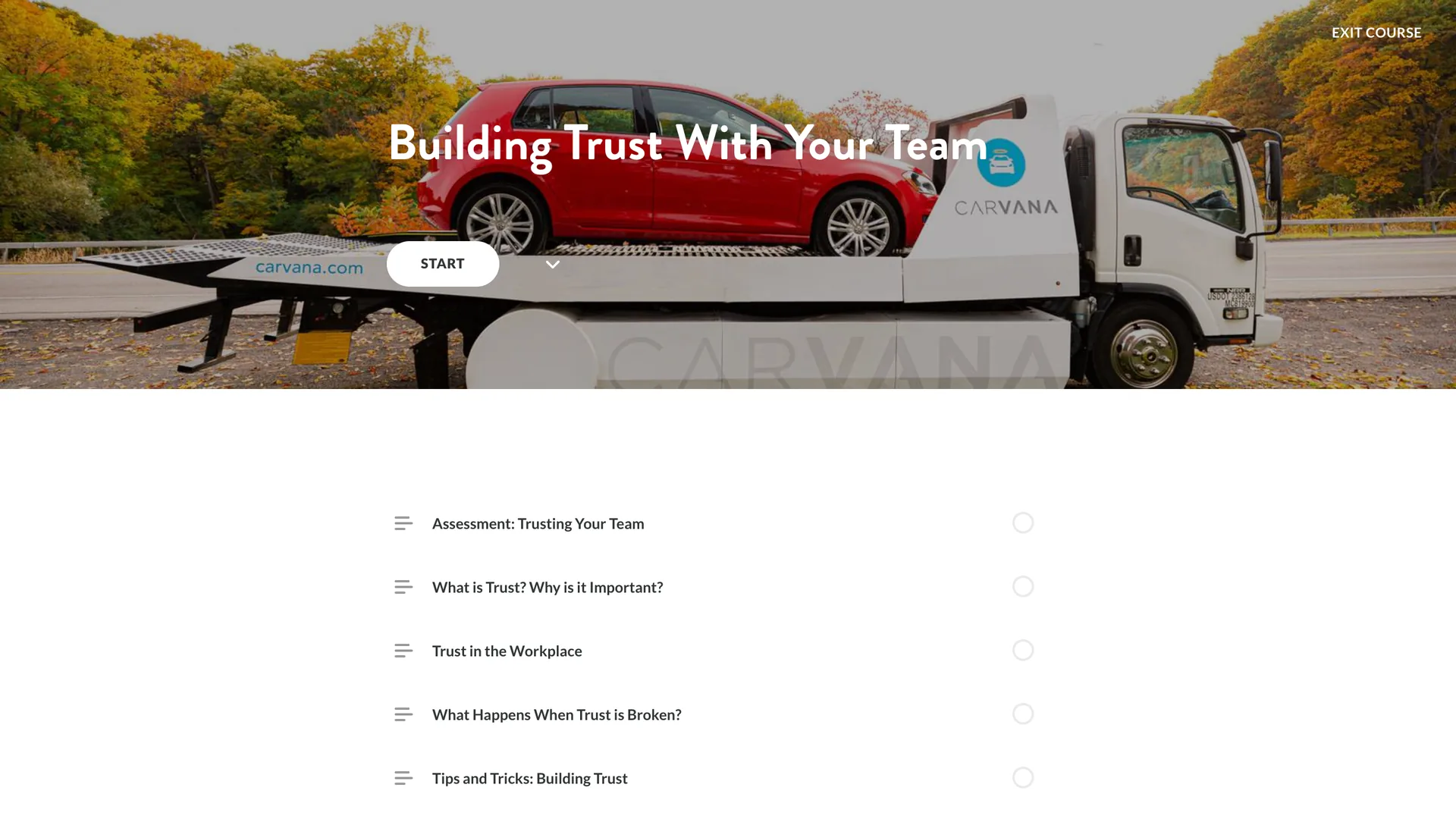
- Storyline blocks inside Rise for a scenario knowledge check on the 4 A’s.
- A worksheet to finish with: turn the course into goals and activities with their own team.
Result
Part of TLIT, the team-lead program I built from the ground up.
What the clip shows
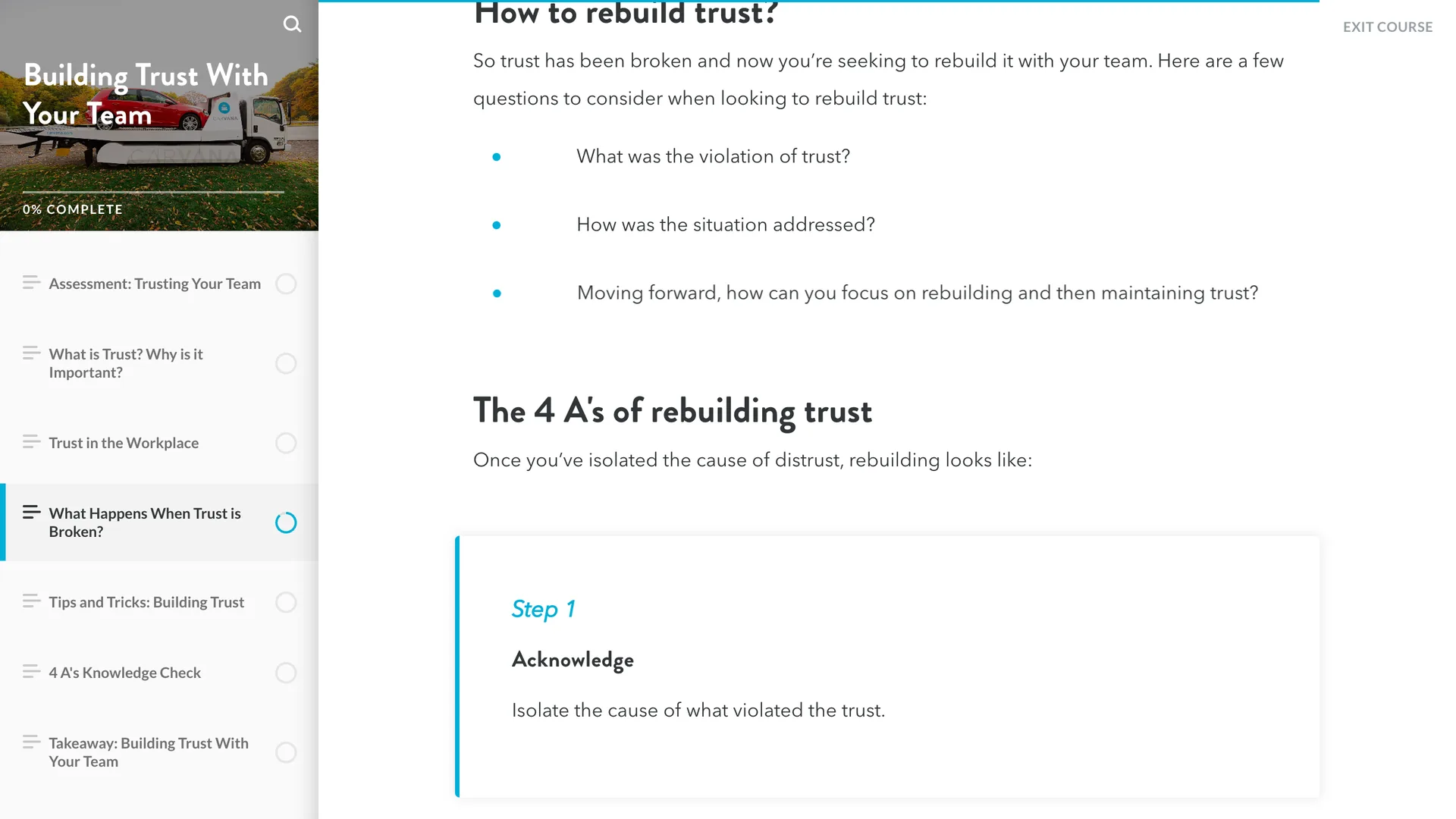
- Building Trust With Your Team: eight short lessons in Rise, after a private self-assessment as pre-work.
- Lessons pair short reading with interactions built as Storyline blocks inside Rise.
- Rebuilding trust follows the 4 A's: Acknowledge, Accept accountability, Adapt, Adhere.
- A scenario knowledge check applies the 4 A's.
- It closes with a worksheet: reflection, SMART goals and activities to run with the team.

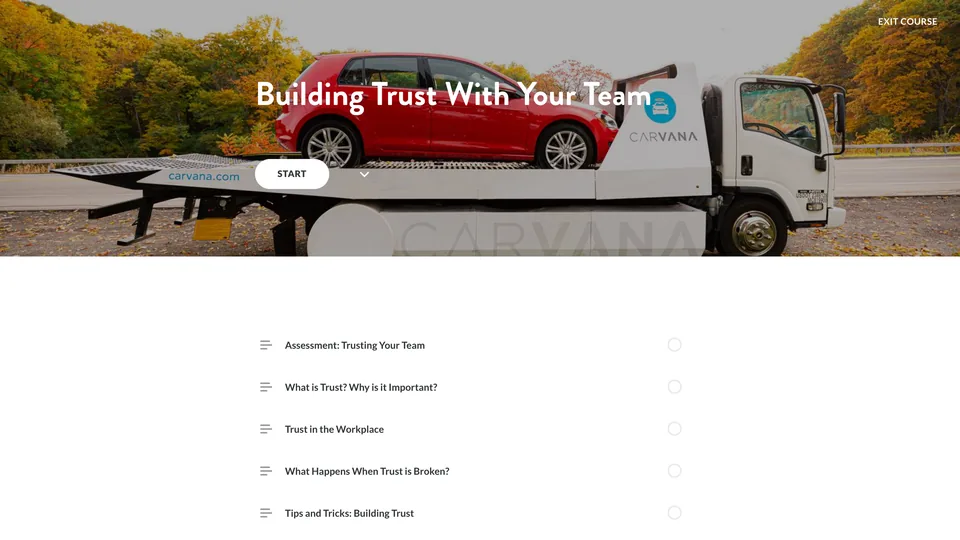
Eight lessons, from the self-assessment to the worksheet. 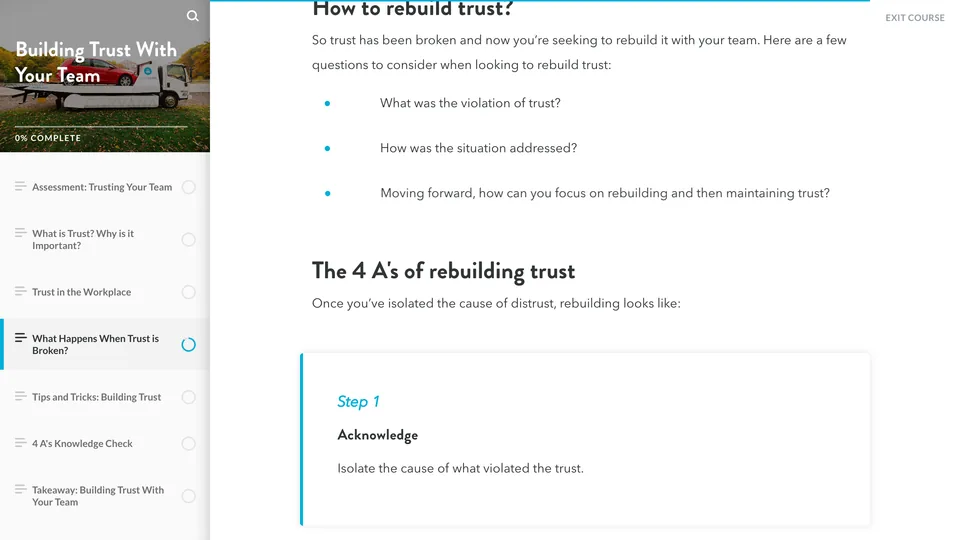
The 4 A’s, one step at a time. 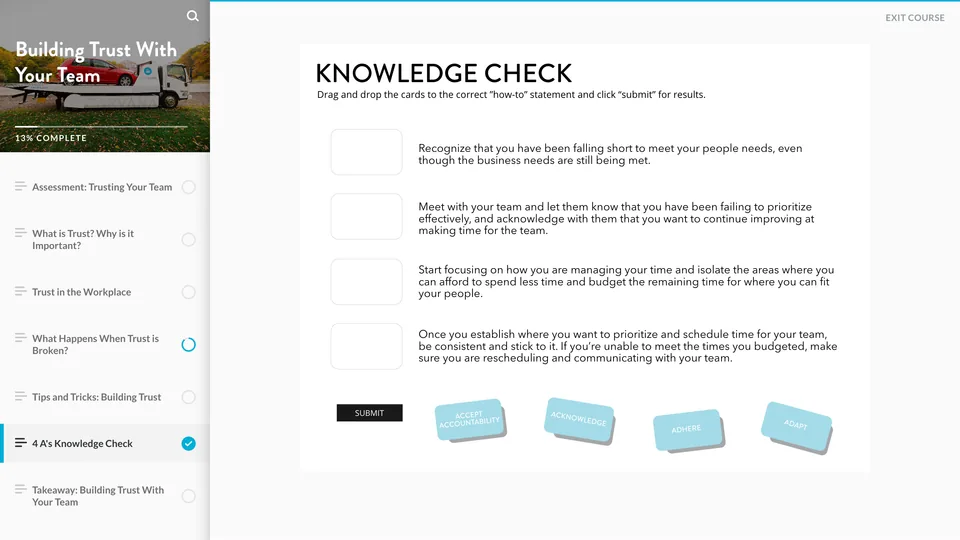
A scenario knowledge check, built in Storyline.
What I build
- Interactive eLearningStoryline games, timelines and knowledge checks
- Scenario practiceAnimated scenarios with instant feedback
- Learning videoEpisodes produced, presented and captioned
- Job aidsOne-page guides and worksheets
- Blended programsPre-work, course and on-the-job worksheet
Built for every learner: captions on video and Storyline courses, and plain language for people whose first language isn’t English.
Where I did it
Project Manager, Learning Experience
Carvana · Jan 2021 – Jan 2022Trained a 13-person cross-functional team on Agile and ran its sprints: 234 learning projects in a 12-month year, for 30,000+ employees.
Team Leader, Onboarding
Carvana · Jan – Aug 2022Led 6 direct reports in building the Onboarding Portal that guides new hires through their first 90 days, and two company-wide knowledge bases.
Multimedia Producer to Senior Multimedia Producer
Carvana · Aug 2018 – Jan 2021First hire on the Leadership Development team. Built TLIT (Team Lead in Training) from the ground up and supported the Workday Learning LMS rollout to 5,000+ employees. Learned 2D animation in two months to keep company communications shipping through COVID-19 lockdowns.
Hiring for learning design?
The quickest way to reach me is a message on LinkedIn. Need my résumé for your hiring team? It’s one click. Prefer email? Use the form: it comes straight to me.
Prefer email?
Thanks. Your message is on its way, and I’ll reply by email.
Your message didn’t send. Please try again in a minute, or reach me on LinkedIn.